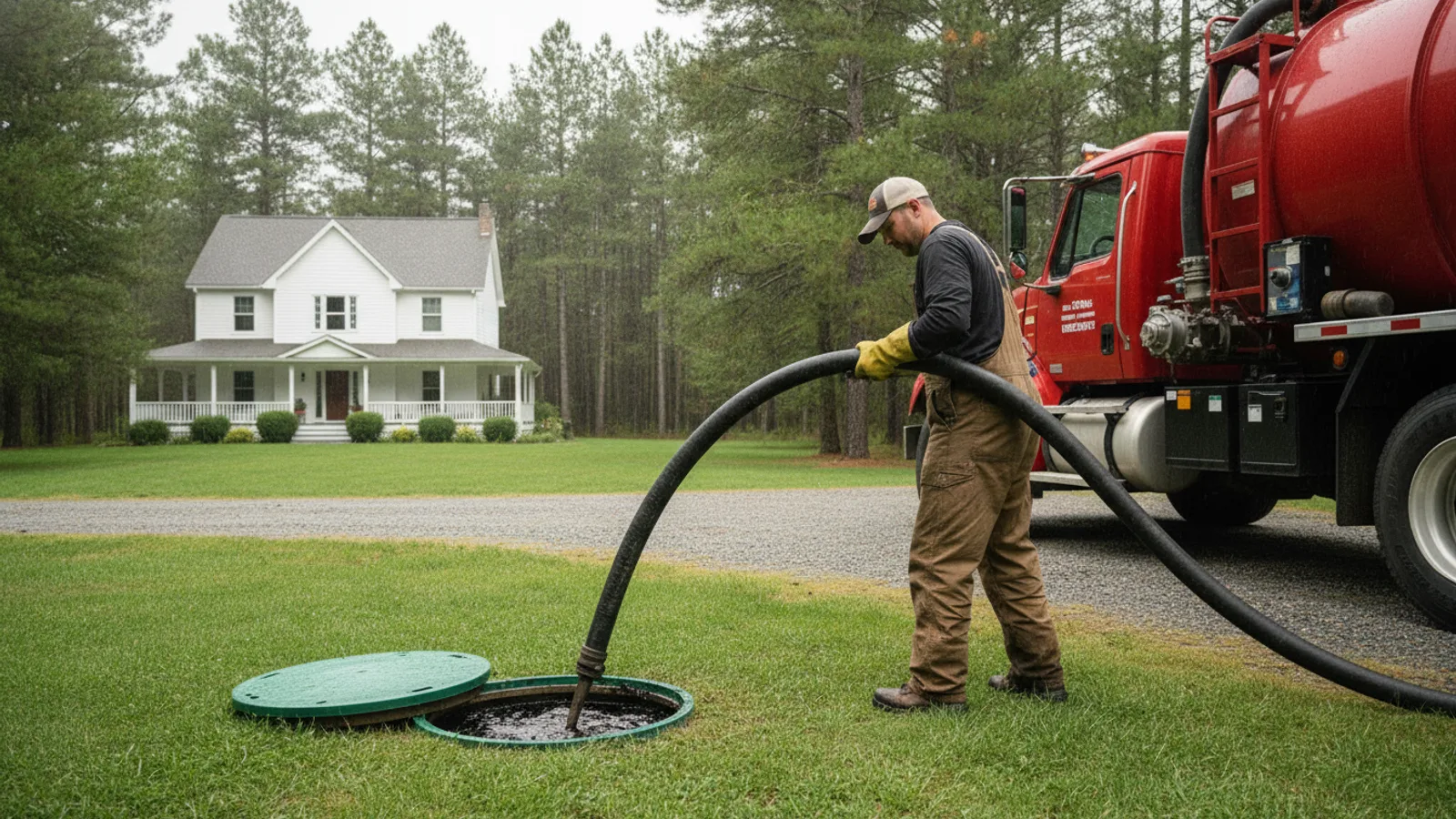
Type “how often to pump septic tank” into a search bar and every site gives you the same answer: every 3 to 5 years. That’s not wrong. But it’s a range wide enough to hide a flooded basement in, and the difference between year three and year five can be the difference between a routine $350 pump-out and a five-figure drain field replacement.
We pump tanks all over the greater Bangor area, from Bangor and Brewer out to Hampden, Old Town, and Orono. After enough driveways, you learn the honest answer isn’t one number. It’s three questions: how many people use the system, how big is the tank, and is this a year-round home or a camp on the lake?
Answer those and you can pin your schedule down within a year. Here’s how to work it out for your own place.
How Often to Pump a Septic Tank: Start With Two Numbers
Everything about pumping frequency comes down to a simple ratio. Your household produces solids at a fairly steady rate, and your tank has a fixed amount of room to store them while bacteria break some of it down. Bigger household, faster fill. Bigger tank, slower fill. That’s the whole game.
Here’s the table we work from, and it matches what most state extension services publish:
| Household size | 750 gallon tank | 1,000 gallon tank | 1,500 gallon tank |
|---|---|---|---|
| 1-2 people | Every 4-5 years | Every 5 years | Every 6+ years |
| 3-4 people | Every 2-3 years | Every 3-4 years | Every 4-5 years |
| 5-6 people | Every 1.5-2 years | Every 2-3 years | Every 3-4 years |
Most Maine homes built in the last few decades have a 1,000 gallon tank and house two to four people. That lands squarely in the 3 to 4 year column, which is exactly where the classic “every 3 years” advice comes from. The EPA’s septic program backs this up, recommending inspection every one to three years and pumping every three to five for a typical household system.
Don’t know your tank size? Check the paperwork from when you bought the house, ask your town office for the system design (Maine towns keep subsurface wastewater records on file), or ask whoever pumped it last. If nobody knows, we measure it when we open it up and write it on your receipt so you never have to guess again.
If you already know you’re past due, skip the math. Book a pump-out online or call (207) 555-0142 and we’ll get you on the schedule, usually within the week.
What Shortens Your Septic Pumping Schedule
The table gives you a starting point. A few things push your septic pumping schedule toward the shorter end, and some of them are sneaky.
- A garbage disposal. Ground-up food is solid waste your tank’s bacteria can’t keep pace with. If you use one regularly, knock a full year off your interval.
- High occupancy. Rentals near the university in Orono are the classic case. Five students produce a family-of-seven load in a tank sized for a family of four.
- An older or undersized tank. Plenty of pre-1980 homes around Penobscot County are running 750 gallon or even 500 gallon tanks. The house grew, the tank didn’t.
- Heavy water use. Old fixtures, long teenage showers, or a toilet that runs all winter push water through the tank faster than solids can settle out.
- A home business. A daycare, a hair salon in the basement, or anything else that adds people and water counts against you.
Here’s what ignoring those factors looks like. Dave in Hampden has a family of five, a 1,000 gallon tank, and a garbage disposal that sees daily use. By the table alone he should’ve been pumping every 2 to 3 years, and the disposal made it closer to two. He went five.
By the time his drains slowed down, solids had floated past the outlet baffle and into his leach field lines. The pump-out plus jetting those lines ran him about $1,400, instead of the roughly $350 a routine pump-out would have cost. He got lucky, honestly. If the field itself had clogged, he’d have been looking at a replacement bill with a comma in it. For a full breakdown of what service runs around here, see our guide to septic pumping costs in Maine.
The lesson isn’t complicated. Adjust the table for how your household actually lives, not how the builder assumed it would.
Camp Septic Pumping: The Maine Seasonal Exception
Now for the part most national advice gets wrong for Maine. Seasonal camps are everywhere up here, and a camp used ten weekends a summer produces a small fraction of a year-round home’s load. A properly sized camp tank can legitimately go 5 to 8 years between pump-outs without anyone being negligent.
Two caveats before you pencil in 2033, though.
First, watch for usage creep. The camp that hosted ten quiet weekends in 2015 might now host every grandkid from June through Labor Day, or it might’ve quietly become a retirement home used eleven months a year. When a camp turns into a house, its septic pumping schedule turns into a house’s schedule too. Recalculate from the year the usage changed, not from the last pump-out.
Second, pump before problems, not after. The worst possible time to learn a camp tank is full is the July weekend the whole family is up. Every pumper in the region is booked solid in high summer, and emergency slots cost more.
Holding Tanks Are a Different Deal
If your camp sits close to the water, there’s a fair chance it’s on a holding tank instead of a full septic system. Shoreland zoning often requires it, because there’s no room for a proper drain field between the camp and the lake. A holding tank has no drain field at all. Everything that goes down the drain stays in the tank until a truck hauls it away.
That changes the whole conversation. Holding tank pumping frequency isn’t measured in years, it’s measured in usage. A busy camp can fill a holding tank in a few weeks. Most tanks have an alarm float that trips when you’re getting close, and that alarm is not a suggestion.
Sue’s camp outside Old Town is a good example. She’s got a 2,000 gallon holding tank, and most summers a scheduled pump or two covers it, at around $350 a visit. Then came the family reunion year. Fourteen people for a week, the alarm tripped on July 3rd, and the holiday emergency pump-out ran her about $600. Now she calls us before any big week at camp and has the tank pumped ahead of time. Cheapest insurance she buys all year.
Why Maine Winters Raise the Stakes
In most of the country, missing a pump-out by a year means a bad week whenever the system finally complains. In Maine it matters a lot more when the system complains, because roughly five months of the year the ground above your tank is frozen solid.
A tank that backs up in January means finding a buried cover under two feet of snow, breaking through frost to reach it, and paying winter emergency rates for the privilege. Mark in Glenburn found that out two winters back. His tank was overdue going into December, backed up in mid-January, and between the frost digging and the emergency call the bill came to about $900. The same pump-out in June would’ve cost him around $350 and an hour of his Saturday.
There’s a system health angle too. A tank pumped on schedule goes into winter with room to spare and comes out healthy in spring. A tank at capacity in November is rolling the dice on the worst season to lose. That’s why our standing advice across Penobscot County is simple: whatever your interval works out to, do the actual pumping between May and October.
Coming up on the three year mark and want it handled before snow flies? Call (207) 555-0142 or grab a slot online. Fall books up fast around here.
Signs You Waited Too Long (and When to Stop DIY)
Tanks rarely fail without warning. Watch for these, roughly in the order they show up:
- Drains running slow all over the house, not just one sink
- Gurgling from toilets or floor drains when you run water
- Sewage smell in the yard, the basement, or near the tank
- Bright green, spongy grass or standing water over the drain field
- Sewage backing up into the lowest drain in the house
One slow sink is a plumbing problem. All of them at once is a septic problem. If you’re seeing the bottom of that list, stop running water and read our guide on what to do when your septic backs up, then call for service.
Now the safety part, and we mean this. Never open a septic tank yourself, and never lean over an open one. The gases inside (hydrogen sulfide and methane, mostly) can drop a healthy adult in seconds, and people die this way every year, sometimes along with the person who tried to pull them out. There’s nothing inside that tank a homeowner needs to see. Finding your tank lid, keeping records, and spreading out laundry loads are great DIY. Anything involving an open tank belongs to a crew with the right equipment.
For everyday habits that stretch the time between pump-outs, the EPA’s SepticSmart guidance is the best free resource going: no grease or wipes down the drain, fix running toilets, and keep vehicles off the drain field. Good septic tank maintenance in Maine looks the same as anywhere, there’s just a harder deadline attached, and it’s called winter.
If You Can’t Remember, It’s Due
Here’s the rule we give everyone, and it settles most of these conversations in one sentence. If you can’t remember when your tank was last pumped, it’s due. Not because we’re trying to sell you a pump-out, but because sludge doesn’t announce itself, and the only cheap time to deal with it is before you have symptoms.
If you do know the date, run your numbers against the table above. Normal household, 1,000 gallon tank, three years since the last service? Book it this season and pick a warm month. Big family or a garbage disposal? You’re probably a 2 year household, whatever the internet’s default says.
And a word of honest caution from inside the trade. If a company tells you your tank needs pumping every single year without ever looking inside it, get a second opinion. For most homes, an annual pump-out isn’t a service, it’s a subscription.
Want a number specific to your tank, household, and town before you call anyone? Run it through our septic pumping cost calculator. Or just talk to a person: call (207) 555-0142 or book your pump-out here and we’ll give you a straight answer and a real date.
Frequently Asked Questions
How often should you pump a septic tank in Maine?
Most Maine homes with a 1,000 gallon tank and two to four people should pump every 3 to 4 years. Bigger households, smaller tanks, or a garbage disposal can shorten that to every 2 years. If you can’t remember your last pump-out, treat it as due now.
How often does a seasonal camp septic tank need pumping?
A camp used a handful of summer weekends produces far less waste than a year-round home, so a well sized camp tank can often go 5 to 8 years between pump-outs. If the camp starts seeing heavier use, recalculate from the year that changed. Holding tanks are a separate case entirely and must be pumped whenever they fill, which can be every few weeks in a busy season.
What happens if you wait too long to pump a septic tank?
Solids build up until they wash past the outlet baffle into the drain field and clog the lines. At that point a $350 pump-out can turn into $1,000 or more in jetting, and a ruined drain field can cost tens of thousands to replace. Slow drains, sewage odors, and soggy ground over the field are the usual warning signs that you’re already late.
Can you pump a septic tank in winter in Maine?
Yes, and we do it when we have to, but frozen ground, buried covers, and snow make winter pump-outs slower and more expensive. Emergency winter calls often cost two to three times a scheduled warm-weather visit. If your tank is due, get it pumped between May and October and go into winter with room to spare.